

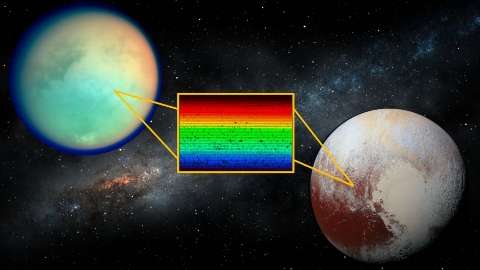
Scientists using the James Webb Space Telescope (JWST) have detected a mysterious signal on Pluto and Titan, Saturn’s largest moon. The discovery suggests that both worlds may contain an unknown molecule that has never been identified anywhere else in the solar system or beyond. Researchers found that a specific wavelength of light, around 5.11 micrometers, is missing from the reflected light of both Pluto and Titan. This missing wavelength, known as an absorption line, usually indicates that a particular chemical is absorbing light. Since every molecule absorbs light at unique wavelengths, scientists use these signals to identify the chemical composition of distant planets and moons.
The James Webb Space Telescope is exceptionally powerful at analyzing light and has already discovered many molecules in the atmospheres of distant planets. In this latest research, scientists examined previously unexplored infrared wavelengths from Pluto and Titan. During the analysis, they discovered the same unexplained absorption signal in both objects. After comparing the signal with previously known chemical signatures, the researchers found no known molecule that matches the absorption line at 5.11 micrometers. This makes the discovery particularly intriguing because the mysterious molecule has never been observed on any other planet, moon, or exoplanet.
The finding is even more surprising because Pluto and Titan are very different worlds. Titan is the largest moon of Saturn and is larger than Mercury. It has thick nitrogen and methane-rich clouds, along with lakes, rivers, and seas of liquid hydrocarbons on its surface. Pluto, in contrast, is a small frozen dwarf planet located far beyond Neptune and is much colder than Titan. Although both worlds have atmospheres rich in methane and nitrogen, scientists believe the mysterious molecule is located on their surfaces, not in their atmospheres.
The unknown substance appears to be much more abundant on Pluto, where the absorption signal is about three times stronger than on Titan. On Titan, the molecule is unevenly distributed, with stronger signals detected on one side of the moon than the other. Researchers have proposed several possible explanations. The mysterious substance could be benzene mixed with another unknown molecule, or it might be a form of acetylene ice or ketene ice. However, none of these possibilities has been confirmed, and additional research is required.
Scientists hope that NASA’s Dragonfly mission, scheduled to launch no earlier than 2028 and arrive at Titan in 2034, will provide important clues. The mission’s onboard scientific instruments could identify the mysterious molecule directly on Titan, helping researchers determine whether the same substance also exists on Pluto. The study has currently been uploaded to the arXiv preprint server and has not yet undergone peer review. If confirmed, the discovery could reveal a previously unknown type of chemistry occurring on icy worlds in the outer solar system and improve our understanding of planetary evolution and chemical processes beyond Earth.