
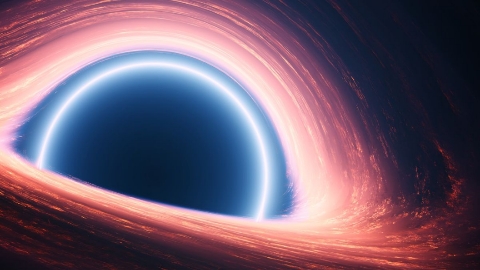
Scientists have made an important breakthrough in black hole research by observing Hawking radiation backreaction in a laboratory experiment. The discovery helps explain how black holes may gradually lose energy over time, a process that has puzzled physicists for decades. For years, scientists have believed that nothing can escape a black hole’s powerful gravity. However, in 1974, physicist Stephen Hawking proposed that black holes are not completely dark. Instead, they slowly emit a tiny amount of thermal energy known as Hawking radiation, causing them to lose mass and eventually evaporate.
Although Hawking radiation is widely accepted in theoretical physics, scientists have never directly observed it around a real black hole because the signal is extremely weak. The biggest mystery has been understanding how energy moves from the black hole into the emitted radiation. This process is called backreaction. To study this problem, researchers from Paderborn University in Germany created a laboratory model that behaves like a black hole. The team was led by physicist Lorenzo Procopio, and the study was published in the journal Nature.
Instead of using an actual black hole, the scientists used ultrafast laser pulses traveling through a specially designed optical fiber. One laser pulse changed the optical properties of the fiber, creating an artificial event horizon, the invisible boundary around a black hole where nothing, not even light, can escape. Earlier experiments using this system successfully reproduced Hawking radiation. In the new experiment, the researchers searched for the much smaller effect called backreaction, which shows how the artificial black hole loses energy while producing radiation.
A simple way to understand backreaction is by imagining two people standing on roller skates. If one person pushes the other forward, the person doing the pushing also moves backward. This happens because every action has an equal and opposite reaction. In the same way, when Hawking radiation carries energy away, the black hole must lose the same amount of energy. During the experiment, scientists detected a tiny change in the laser pulse that created the artificial event horizon. This small shift provided clear evidence of backreaction, showing that energy was transferred from the black hole analog into the emitted radiation.
The findings also challenged previous theories. Scientists had believed Hawking radiation in laboratory systems was produced through a complicated series of optical interactions. Instead, the new results suggest that both Hawking radiation and backreaction are created through a single, direct physical process, making the phenomenon much easier to understand. Researchers believe this discovery could improve theoretical models of real black holes. Although observing Hawking radiation from an actual black hole remains impossible with current technology, similar results in other laboratory systems would strengthen the evidence that the same mechanism operates in space.
The study may also help scientists solve one of physics’ biggest mysteries, the black hole information paradox, a problem that Stephen Hawking continued to study until his final scientific paper in 2018. This breakthrough provides one of the strongest experimental clues yet about how black holes slowly evaporate and could bring physicists closer to understanding some of the Universe’s deepest secrets.