

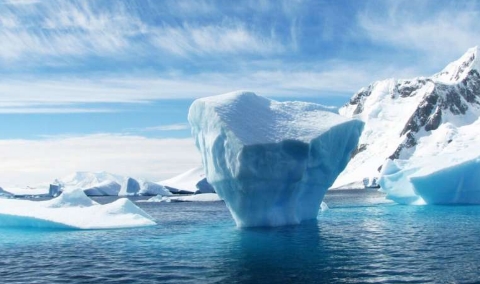
The Southern Ocean surrounding Antarctica has puzzled scientists for years. While most of the world’s oceans have warmed because of greenhouse gas emissions, the Southern Ocean cooled during the late 20th and early 21st centuries. During the same period, Antarctic sea ice briefly expanded before later declining, creating a climate mystery. A new study published in Geophysical Research Letters offers a clearer explanation. Researchers found that human-caused ozone depletion over Antarctica played a major role in cooling the Southern Ocean between 1982 and 2005. The findings show that changes in the atmosphere can directly affect ocean temperatures and even influence Antarctic sea ice.
How the Ozone Hole Changed Ocean Temperatures
The Antarctic ozone hole formed because of human-made chemicals released during the 20th century. As ozone levels declined, the lower stratosphere cooled, changing the temperature difference between the polar region and the tropics. These atmospheric changes strengthened the powerful westerly winds that circle Antarctica and shifted them closer to the continent. According to researchers led by Shouwei Li of Princeton University, these stronger winds also affected the ocean by changing the movement of seawater.
Stronger Winds Carried Cold Water Northward
The stronger winds increased a process known as Ekman transport, which pushes surface water with the wind while Earth’s rotation changes its direction. South of about 46° South latitude, this process moved cold surface water away from Antarctica and spread it farther north across the Southern Ocean. As a result, much of the ocean surface became cooler. Although some areas gained heat from the atmosphere, that warming was too weak to offset the much stronger cooling caused by the wind-driven movement of cold water.
Deep Ocean Processes Created a Slower Warming Effect
The study also examined what happened beneath the ocean’s surface. As winds became stronger, they increased upwelling, a process that brings deeper water toward the surface. Since this deeper water is often warmer than the surface, it can slowly warm the ocean over time. However, researchers found that this warming effect developed much more slowly than the rapid surface cooling. Over several decades, the stronger wind-driven cooling remained the dominant influence.
Impact on Antarctic Sea Ice
The cooler ocean also affected Antarctic sea ice. Climate models suggest that ozone-driven cooling contributed to sea ice expansion in some regions, especially the Ross Sea. This matches satellite observations showing that some parts of Antarctica gained sea ice even while the planet continued warming.
However, the effect was not the same everywhere. Some regions experienced more sea ice, while others continued losing it because of differences in winds, ocean heat transport, temperature, and salinity. The researchers emphasize that ozone depletion alone cannot explain all observed changes in Antarctic sea ice.
Why This Study Matters
The findings also help explain why climate models often predict Southern Ocean warming while observations showed periods of cooling. Greenhouse gases remain the strongest driver of long-term global warming. However, ozone depletion created a temporary regional cooling effect that partly masked greenhouse warming in the Southern Ocean. The study concludes that the Southern Ocean is influenced by several competing climate factors rather than a single cause. It also shows that the unusual cooling observed between 1982 and 2005 was partly a fingerprint of human-caused ozone depletion, highlighting the complex relationship between the atmosphere, oceans, and Antarctic sea ice.