

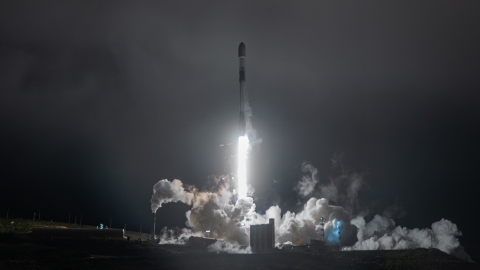
SpaceX successfully launched its Transporter-17 rideshare mission on July 7 using a Falcon 9 rocket from Vandenberg Space Force Base in California. The rocket lifted off at 3:12 a.m. Eastern Time and carried 81 payloads, including satellites and hosted payloads that will be deployed into orbit. The largest satellite on the mission was South Korea’s CAS500-4, a 514-kilogram Earth observation satellite designed for agriculture and forestry monitoring. SpaceX had previously launched the related CAS500-2 satellite in May.
The mission also included satellites from several well-known companies. Iceye launched four radar imaging satellites, Spire deployed ten Lemur satellites, and Japan’s Axelspace sent seven GRUS-3 Earth observation satellites into space. For years, many satellite companies have depended on SpaceX’s Transporter rideshare program because it offers an affordable and reliable way to launch small satellites. However, concerns are growing that SpaceX may reduce or eventually end the program using the Falcon 9 rocket.
According to several industry partners, SpaceX is no longer accepting new Transporter bookings beyond late 2028 or early 2029, and most upcoming missions are already nearly full. As a result, companies such as Exolaunch and SEOPS are arranging their own Falcon 9 rideshare launches instead of relying solely on SpaceX’s shared missions. SpaceX has not officially confirmed these reports. During the Transporter-17 livestream, the company simply said that rideshare missions continue to provide affordable access to space for small satellite operators around the world.
Industry concerns were also highlighted by Adam Spice, Chief Financial Officer of Rocket Lab, during the Spacetide Conference on July 7. He said many customers are becoming increasingly worried about the future availability of both the Transporter program and the Falcon 9 rocket. These concerns are linked to SpaceX’s long-term plans. The company has previously stated that Falcon 9 launches are approaching their peak, while future missions will gradually shift to Starship, its fully reusable heavy-lift rocket.
Spice believes SpaceX will likely use more Falcon 9 launches for its own projects, such as expanding the Starlink satellite network and launching future orbital data center satellites. This could reduce launch opportunities for commercial customers. Because of this uncertainty, Rocket Lab says more companies are signing long-term launch agreements for its upcoming Neutron rocket to secure future access to space. According to Spice, obtaining launch opportunities is becoming more difficult rather than easier. He believes the current concerns may only be the beginning of a much larger challenge for the commercial space industry.