

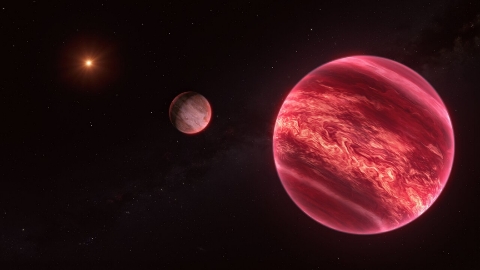
Since the discovery of the first planet outside our Solar System in the 1990s, astronomers have identified thousands of exoplanets. NASA’s catalog now includes more than 6,000 confirmed exoplanets. Surprisingly, however, scientists have not yet confirmed the existence of a single exomoon, which is a moon orbiting a planet outside our Solar System. Considering that moons are common throughout our own Solar System, it is reasonable to expect that other planetary systems should also contain them. The challenge is that exomoons are extremely difficult to detect because they are much smaller and fainter than the planets they orbit.
This long search may finally be approaching a breakthrough. Astronomers have recently identified an unusual object that could represent the first known exosatellite. More importantly, the discovery is forcing scientists to rethink the traditional definitions of both planets and moons. Using the Very Large Telescope, researchers observed an unusual stellar system called CD-35 2722, located about 73 light-years from Earth. The central star has roughly half the mass of our Sun and is orbited by a brown dwarf. Brown dwarfs are objects that form like stars but do not have enough mass to sustain hydrogen fusion in their cores. As a result, they are larger than giant planets but smaller than the smallest true stars, with masses ranging from about 13 to 80 times that of Jupiter.
The biggest surprise came when scientists discovered another object within this system. Unlike the moons in our Solar System, which orbit planets, this object orbits the brown dwarf instead. This makes the system very different from anything previously observed and raises important questions about how celestial bodies should be classified.
According to lead researcher Kevin Hoh of Universidad Diego Portales and the Millennium Nucleus of Young Exoplanets and Their Moons, describing this system using the familiar terms “planet” or “moon” is not straightforward. The newly discovered object is massive enough to be considered a planet, yet it does not orbit a star. Instead, it revolves around a brown dwarf that itself orbits a star. Because of this unusual arrangement, the research team currently refers to it as a moon, even though it is nothing like the small, rocky moons found in our Solar System. Their findings were published in the journal Nature on 22 July.
Despite the excitement, the researchers are not yet ready to officially classify the object as the first confirmed exomoon. Doing so would require a significant revision of the scientific definition of a moon. Team member Alice Zurlo explained that the newly discovered body is a giant gaseous object orbiting another body that is several times more massive than Jupiter. In systems like CD-35 2722, the traditional boundaries separating stars, planets, and moons become blurred, making classification far more complicated than in our own Solar System.
Regardless of its final classification, the researchers are confident that this object is an exosatellite, marking the first discovery of its kind in the history of astronomy. Scientists also expect the Extremely Large Telescope, currently under construction in Chile, to play a major role in finding more exomoons and similar objects in the coming years. Until the true nature of this remarkable object is fully understood, one conclusion is already clear. The discovery once again demonstrates that planetary systems across the universe are far more diverse, strange, and fascinating than scientists ever imagined.