

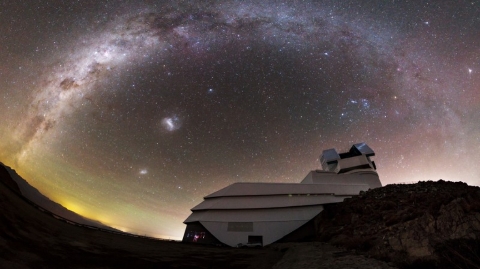
When we look at the night sky, the stars appear motionless, but modern astronomy shows that the universe is constantly changing. New stars are born, old stars die, asteroids race through space, and powerful supernova explosions briefly light up the cosmos before fading away. Scientists have long dreamed of recording these changes like a giant time-lapse movie, and that dream is now becoming a reality.
The Vera Rubin Observatory, located in Chile, has begun an extraordinary mission to capture the changing universe over the next ten years. Through the Legacy Survey of Space and Time (LSST), the observatory will repeatedly photograph the visible night sky and create the most detailed map of the universe ever produced. Astronomers describe this ambitious project as a “10-year movie of the universe” because it will reveal how celestial objects change over time.
According to LSST lead astronomer Željko Ivezić, this survey is unlike any previous astronomy project. No single observatory has ever monitored such a large portion of the sky with this level of sensitivity while repeatedly observing it for an entire decade. This unique approach will allow scientists to detect changes that were previously impossible to observe.
The observatory is equipped with an advanced telescope featuring an 8-meter-wide mirror. One of its most innovative designs is that the primary and tertiary mirrors are combined into a single structure, reducing weight and allowing the telescope to move much faster. Its highly advanced mount can reposition the telescope in just five seconds with almost no vibration, enabling it to quickly scan different regions of the sky.
Another remarkable feature is its enormous digital camera, the largest ever built for astronomy. With an incredible resolution of 3,200 megapixels and a weight of about 3,000 kilograms, the camera can capture an area of the sky equal to approximately 45 full moons in a single image. Its image quality is so high that it could clearly photograph a golf ball from a distance of 25 kilometers. Viewing one full-resolution image would require a display made from 378 Ultra HD 4K televisions arranged together.
The LSST survey is expected to identify and analyze nearly 40 billion celestial objects, making it the largest astronomical catalog ever created. This number is about five times greater than the current human population on Earth. The enormous amount of data collected will significantly improve scientists’ understanding of galaxies, stars, asteroids, dark matter, and many other cosmic phenomena.
One of the most exciting aspects of the project is its real-time alert system. Whenever the observatory detects a new or unusual event in the night sky, it will automatically send millions of alerts to astronomers around the world. This rapid notification system will help researchers quickly study rare events before they disappear. Scientists are especially excited about the possibility of discovering more interstellar objects, such as Comet 3I/ATLAS, which travel into our Solar System from distant star systems. Researchers believe the Vera Rubin Observatory could discover dozens of these rare visitors during its decade-long mission, opening a new chapter in our understanding of the universe.