

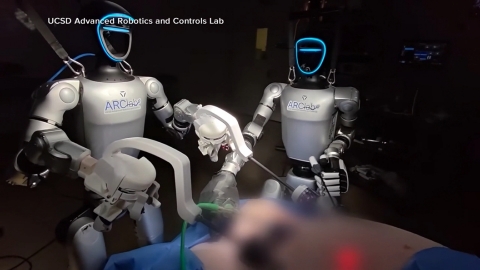
Scientists have achieved a historic milestone in medical science by successfully performing surgery on a living animal using a pair of humanoid robots for the first time. A team of engineers and surgeons from the University of California, San Diego, carried out the breakthrough, and the research has been published in the journal Nature. Under the direct remote control of experienced surgeons, two humanoid robots successfully removed the gallbladder of a living pig using a minimally invasive laparoscopic procedure. The operation marks a major step toward expanding the role of humanoid robots in modern healthcare.
Robotic surgical systems such as the da Vinci platform have been used in hospitals for years, but this is the first successful surgery performed by humanoid robots with human-like bodies and two legs. The researchers used robots nicknamed “Surgi,” which are based on the Unitree G1 humanoid robot developed in China. Each robot stands about 5 feet tall, weighs around 27 kilograms, and is controlled remotely through a specialized surgical console. During the first operation, one human surgeon and one humanoid robot worked together, while in the second procedure, two humanoid robots cooperated with each other to complete the surgery. Although minor bleeding occurred during the operation, the robots responded quickly to the surgeons’ instructions, controlled the bleeding, and successfully removed the gallbladder.
Traditional robotic surgical systems currently used in hospitals can weigh nearly 800 kilograms, cost millions of dollars, and require large operating spaces. In contrast, these humanoid robots are lightweight, more affordable, and capable of working in environments designed for human movement. Researchers were also able to adapt standard surgical instruments with only minor modifications, making the system more practical and easier to deploy in different healthcare settings.
According to surgical expert Dr. Shanglei Liu, the greatest advantage of this technology is its portability. The humanoid robotic system is significantly less expensive than conventional surgical robots and requires much less space to operate. These features could make remote surgery possible in rural communities, disaster zones, battlefields, and even future space missions where specialist surgeons are unavailable. Researcher Ryan Broderick added that surgeons could remotely perform complex procedures in underserved regions with limited equipment and fewer medical assistants, greatly improving access to advanced healthcare.
Despite the successful demonstration, the technology is not yet ready for use in human patients. Researchers observed that slight communication delays and occasional recalibration were required during remote operation. Even so, they believe that advances in robotics, artificial intelligence, and remote control systems will allow humanoid surgical robots to reach clinical readiness much faster than previous generations of robotic surgery technology, potentially transforming healthcare delivery around the world.