

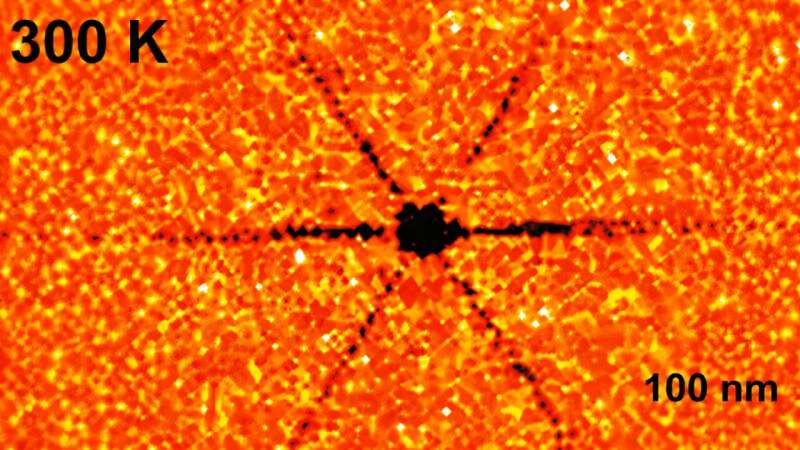
Researchers at the UCLA Samueli School of Engineering have made a breakthrough by observing quantum heat waves at room temperature, a discovery that could transform the way heat is managed in future electronic devices. Until now, this type of wave-like heat movement, called phonon focusing, had only been seen at extremely low cryogenic temperatures, making it difficult to use in practical technologies. The new research shows that atomic vibrations known as phonons can travel in focused, ray-like paths even at normal room temperature, opening the door to more efficient cooling methods for advanced electronics.
The study focused on boron arsenide, a semiconductor crystal known for its exceptionally high thermal conductivity. Instead of allowing heat to spread randomly in every direction, the crystal naturally guides heat along specific paths determined by its atomic structure. This behavior is similar to the way optical fibers direct light, allowing heat to be controlled with remarkable precision at the nanoscale.
To observe this phenomenon, the research team developed a highly sensitive nanoscale temperature-mapping technique. In ordinary materials, heat spread outward in smooth circular patterns, which is typical of conventional heat conduction. In boron arsenide, however, the scientists observed clear ray-like patterns, proving that heat was being directed along the crystal’s internal structure instead of diffusing evenly.
The researchers also found that changing the orientation of the crystal produced different heat-flow patterns, including sixfold, eightfold, and fourfold shapes. These guided heat waves remained stable over distances of about one micrometer and may extend to several tens of micrometers, making them suitable for use in modern microelectronics, photonic systems, and quantum technologies.
According to the researchers, this discovery introduces a completely new way of thinking about thermal management. Rather than removing heat after it has already spread throughout a device, engineers may be able to direct heat exactly where it should travel. Such precise control could improve the performance, reliability, and lifespan of processors, AI hardware, aerospace electronics, and other high-performance systems that are often limited by overheating.
The breakthrough also has important implications for quantum technologies. Better control of phonons could improve how heat interacts with electrons and other energy carriers, supporting future developments in quantum computing, sensing, and information processing. Previous studies suggested that wave-like heat transport could not survive at room temperature because phonons scatter too frequently. However, boron arsenide has unusually weak phonon scattering, allowing these quantum heat waves to travel much farther than expected.
The experimental results closely matched theoretical predictions, confirming that phonons can maintain their wave-like behavior over relatively long distances at room temperature. This achievement builds on earlier work by Professor Yongjie Hu and his team, who first demonstrated the remarkable thermal properties of boron arsenide and have continued developing advanced cooling technologies using this material. The new findings provide a strong foundation for the emerging field of quantum thermal engineering and may help shape the next generation of electronic and quantum devices.