

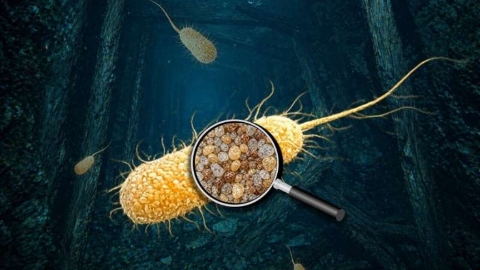
Scientists have discovered that certain bacteria can transform toxic uranium dissolved in water into a stable chemical compound within 130 days. The research was carried out by scientists from the Helmholtz-Zentrum Dresden-Rossendorf (HZDR), Wismut GmbH, and the University of Granada in Spain. The findings were published in the journal Nature Communications. The discovery could become an important step toward developing biological methods for cleaning uranium-contaminated water and reducing environmental pollution.
How the Bacteria Removed Uranium
Bacteria naturally live in soil and water, where many species help break down harmful substances. Researchers already knew that some bacteria could use dissolved uranium during their metabolism when supplied with glycerol, a simple carbon-rich compound found in plant and animal fats. To understand how effective this process is, scientists collected water from a flooded uranium mine in Germany. The experiments were carried out in an oxygen-free laboratory environment, similar to the conditions found about 2,000 meters (6,600 feet) below the surface.
After adding glycerol, the bacteria began using it as food. Over the next 130 days, they removed almost all of the dissolved uranium from the water. By the end of the experiment, only about 5% of the uranium remained.
Uranium Was Stored Inside Bacterial Cell Walls
Researchers found that the bacteria did not simply remove uranium from the water. Instead, they trapped it inside their cell walls, preventing it from remaining dissolved in the surrounding water. Advanced microscopic and spectroscopic analyses confirmed that uranium had accumulated within the bacterial membranes.
Scientists Found a Rare Form of Uranium
Further investigation revealed an unexpected discovery. Uranium is normally found in chemical states with a valency of 4 or 6. However, the bacteria produced a rare pentavalent uranium (U(V)), a form that had previously been considered unstable and only temporary. Finding such a large amount of pentavalent uranium surprised the researchers because it had rarely been observed in nature.
A Stable Uranium Compound Formed
The rare uranium combined with iron and oxygen to create a compound known as FeU(V)O₄. This compound was first identified in 2020 in soil contaminated by uranium ammunition in Croatia. Scientists had already observed that it remained stable for more than 25 years, even when exposed to oxygen. The new study is the first to show that bacteria naturally produce this stable uranium compound.
Oxygen Made the Compound Even More Stable
Researchers also discovered something unexpected. When the dried bacterial material was exposed to oxygen, the amount of FeU(V)O₄ increased instead of breaking down. This suggests the compound becomes even more stable under normal atmospheric conditions.
Why This Discovery Matters
Toxic uranium dissolved in water poses risks to both humans and the environment. Converting it into a stable solid compound could make contaminated sites much safer. Although more research is needed, scientists believe these bacteria may eventually become a valuable tool for cleaning uranium-polluted groundwater, mining sites, and other contaminated environments. Future studies will focus on understanding exactly how these bacteria bind uranium and whether the process can be applied to large-scale environmental remediation projects.
Source: phys.org