

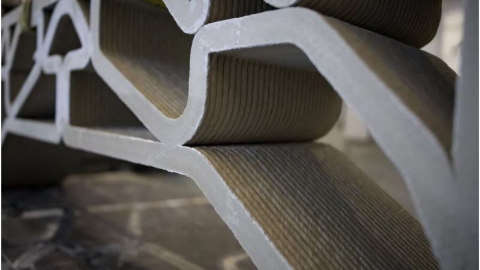
Concrete is the most widely used construction material in the world, but it is also one of the largest contributors to global carbon emissions. One of the most promising ways to reduce its environmental impact is 3D concrete printing, which builds structures layer by layer without using traditional molds. This method reduces material waste, lowers labor requirements, and places concrete only where it is structurally needed, making construction more efficient and environmentally friendly.
However, many of the lightweight and highly efficient designs created through computer optimization cannot be built using current 3D concrete printers. Engineers commonly use topology optimization to create structures that require the least amount of material while maintaining maximum strength. Although these designs are mathematically ideal, they often contain complex shapes that today’s printers cannot produce because of limitations such as thick printing nozzles, restricted turning angles, and the need to print in one continuous path.
Researchers at the Massachusetts Institute of Technology (MIT) have developed a new design framework that solves this problem by incorporating the real manufacturing limitations of 3D concrete printers directly into the optimization process. Instead of creating designs that require extensive manual modifications before printing, the new system automatically generates structures that are ready to print with little or no redesign. The team successfully demonstrated the method by designing, printing, and testing a 2.3-meter-long concrete bridge.
To ensure the framework reflected real-world printing conditions, the researchers collaborated with engineers operating large-scale 3D printers at Autodesk’s Boston facility. These discussions identified three major printing limitations: the minimum width of each concrete bead, the sharpness of turns the printer nozzle can make, and the requirement to print continuously without interruptions. The researchers converted these practical limitations into mathematical rules, allowing the software to create designs that printers can build successfully.
Unlike traditional optimization methods, which often require days of post-processing to make designs printable, the new framework generated fully printable bridge designs in about two minutes using a standard laptop. Even when the researchers needed to resize the bridge shortly before printing, the software produced a revised design within just five to ten minutes. This significant improvement became possible because of recent advances in mixed-integer optimization algorithms and computing power.
The completed bridge weighed approximately 900 pounds and took only about 30 minutes to print using commercially available mortar. During structural testing, it successfully supported more than 2,000 pounds of concrete blocks without any measurable bending, closely matching the researchers’ computer simulations. The experiment confirmed both the accuracy of the design method and the structural reliability of the printed bridge.
The study also revealed an unexpected finding. The biggest limitation was not the strength of concrete itself but the capabilities of current 3D printing hardware. The researchers discovered that printer constraints forced designs to use more material than theoretically necessary. Their analysis showed that reducing the concrete bead width from 4 centimeters to just 1 centimeter could decrease material usage by as much as 76 percent while still maintaining safe structural performance. This finding provides valuable guidance for future printer development and highlights how relatively small hardware improvements could significantly reduce concrete consumption and carbon emissions.
Another important feature of the bridge is that every part of its structure remains under compression, which is the condition where concrete performs best. Concrete is extremely strong when compressed but weak when subjected to tension. This principle became evident after testing when the bridge, despite supporting over 2,000 pounds during load tests, fractured after one corner was lifted a few inches from the ground. The lifting introduced tensile forces that the bridge was never designed to resist, demonstrating the importance of compression-only structural design.
Beyond reducing material use, 3D concrete printing also eliminates the need for expensive formwork, making it especially valuable for unique structures and emergency construction projects. The researchers believe this technology could play a major role in disaster relief by allowing essential infrastructure to be built quickly without requiring custom molds. Looking ahead, the team plans to expand the technology by integrating steel reinforcement into 3D-printed concrete structures, although developing reliable methods for automatically placing reinforcing bars during printing remains a significant engineering challenge.