
China has introduced another powerful artificial intelligence model that has surprised the U.S. technology industry. The new model, called Kimi K3, was developed by the Beijing-based startup Moonshot AI. Experts say it performs at a level comparable to some of the most advanced AI models from OpenAI and Anthropic, showing how quickly China’s AI industry is closing the gap with leading American companies.
Kimi K3 has attracted significant attention because of its strong coding abilities. According to the AI evaluation platform Arena, the model ranks at the top for front-end coding performance. Arena CEO Anastasios Angelopoulos described the launch as one of the biggest AI releases of the year, suggesting that open-source Chinese AI models are now beginning to outperform some closed-source models developed in the United States.
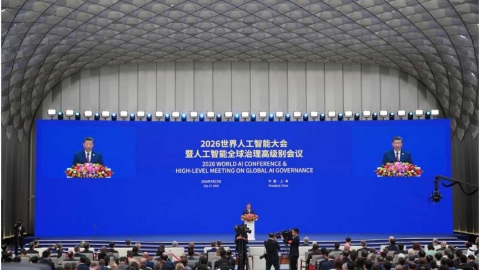
The announcement of Kimi K3 came just before Chinese President Xi Jinping delivered the opening speech at the 2026 World Artificial Intelligence Conference in Shanghai. During his address, Xi emphasized that artificial intelligence should be developed through international cooperation rather than being dominated by a single country. His comments reflected China’s growing ambition to become a global leader in AI despite facing U.S. technology restrictions.
Kimi K3 is the latest in a series of major AI releases from Chinese companies. Last month, Chinese startup Zhipu introduced its GLM-5.2 model, which has gained popularity among software developers for offering high performance at a lower cost than many leading U.S. AI systems. Earlier, DeepSeek also gained worldwide attention after releasing an advanced AI model that shook the global technology market.
The rapid progress of Chinese AI companies is supported not only by software development but also by advances in hardware. At the World Artificial Intelligence Conference, Huawei showcased its new Atlas 950 SuperPoD AI computing system. This demonstrates China’s increasing ability to develop its own AI infrastructure despite U.S. restrictions on advanced chips from companies such as Nvidia. Although Moonshot has not revealed which hardware was used to train Kimi K3, the company is known to work closely with Huawei.
While Kimi K3 is the most expensive Chinese AI model released so far, it still costs only about half as much as OpenAI’s GPT-5.6 Sol model. This competitive pricing could make it an attractive option for businesses and developers seeking high-performance AI at a lower cost. The rise of Chinese AI models has also intensified concerns among U.S. companies. OpenAI and Anthropic have accused several Chinese AI developers, including Moonshot, DeepSeek, and MiniMax, of using a technique known as AI distillation to copy the capabilities of leading American models. These companies argue that such practices allow competitors to build advanced AI systems more quickly and at a much lower cost. However, the Chinese government has rejected these allegations, calling them baseless.
Despite the controversy, cooperation between AI companies continues in some areas. The San Francisco-based startup Anysphere confirmed that one of its popular coding products was built using Moonshot’s earlier K2.5 model. This highlights how Chinese AI technology is already influencing software development beyond China.
Moonshot’s co-founder and CEO, Yang Zhilin, earned his Ph.D. from Carnegie Mellon University in the United States in 2019. His former professor, Russ Salakhutdinov, praised Kimi K3 as a major achievement for the open-source AI community, showing that scientific collaboration can continue despite growing competition between the United States and China. The release of Kimi K3 marks another important milestone in the global AI race. It demonstrates that Chinese AI startups are rapidly improving their technology, offering powerful and affordable alternatives to leading American AI models. As competition continues to grow, the development of advanced AI is expected to accelerate worldwide, bringing both new opportunities and new challenges for the technology industry.